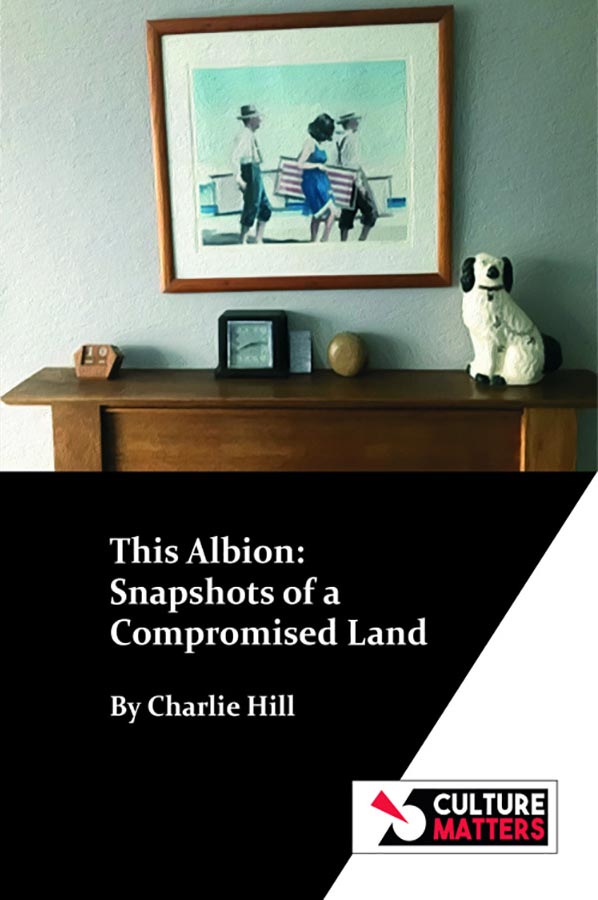
This Albion
In 21 pieces about a variety of urban and rural locations in England, Scotland and Wales, Charlie Hill takes us on a tour of post-industrial Britain. From escaping to the Highlands during the pandemic to a trip to a Soho boozer, from camping in a church in Herefordshire to playing football in inner-city Birmingham, from feeling twitchy in a Gwynedd resort town to a run-in with the builders of HS2, This Albion draws on the theories of the Situationists and the writing of Mark Fisher to create an original and accessible snapshot of a society divided and brought together by geography and class.
‘Charlie Hill’s ‘snapshots’, literal and metaphoric, sustain a nice balance between happenstance and revelation. He moves off from the first direct utterance, through a series of encounters and epiphanies across a fractured kingdom of used-book pits, stalled trains, convenience stores, memory resorts, in quest of the telling detail. Which, in some cases, he is too tactful to expose. Topography becomes confession, as we realise that the weather is all inside. These anecdotes of otherness are a good-hearted adjudication of a naked self. And that’s more than enough to ask of prose that understands just where to stop.’ Iain Sinclair
‘Charlie Hill's This Albion is a remarkable socio-cultural examination of Britain today. Hill writes with a beautiful prose style that is sharp, poetic, funny, tragic and full of life.' Aaron Kent
'Charlie Hill is a modern day walker-writer. This is a collection of thought-provoking, often joyous, always fascinating observations that blaze with insight about the dynamic link between people and place.' Kerry Hadley-Pryce
‘I'm yet to meet a Charlie Hill book I don't like. A true writers' writer. This Albion is no exception, as he takes us on a beautiful, hilarious, dark and awe-inspiring peregrination through the off-kilter and unusual landscapes of the UK. Graveyards give way to abandoned warehouses that lead us to bookshops and canal tow paths, punctuated occasionally with a glimpse and echo of sublime and uncanny birds. Hill notices things others don't - he's a poet in that sense, and draws us closer to what is most beautiful and what is most bleak in the everyday moments and everyday things that are always present, but so often seem insignificant. These travelogue vignettes give us a taste of this idiosyncratic world but build into each taste a stratigraphic studying of place-identity - the way places shape us and how we affect them.’ Dr Rob Francis
'For Hill, to move is to think is to write.' Elliptical Movements
'Though simple and straightforward on the surface, Hill’s writing conjures up a deep poetic beauty.' Psychogeographic Review
‘Perhaps I pre-empted his own question, as he later ponders whether this observation — this recording diaristically of surfaces — has appropriate value. The question arises in the text itself, as Hill challenges his own approach, nakedly recording his doubts as to whether the political urgency of the present moment demands a more participatory writing. It’s a dangerous move for an artist, a speaker, or a teacher, to reveal their own doubts: it can dent the confidence that you’d wish to cultivate among your audience. But, by this point, Hill has set out his stall and we will already have decided whether or not to trust him. His gamble pays off: and he ends on a sort of cliff-hanger for his own artistic development, perhaps aware that his thoughts will find a mirror in his readers’ and their own struggles with complicity, complacency and praxis.’ The Urban Wanderer
Voce Books, 2024